Why a Clear Route Makes a Small Patio Feel More Usable
A clear route through a small patio helps define useful areas, ease everyday movement and show where furniture or planters can fit without blocking access.
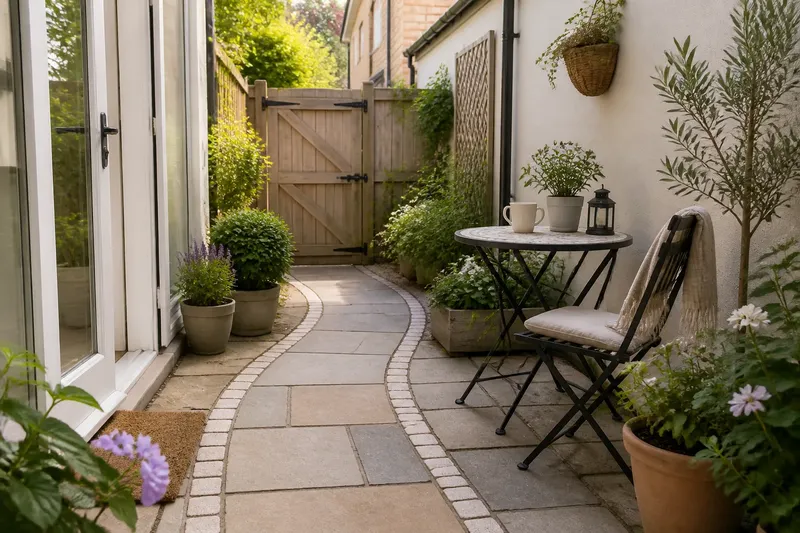
You step outside with a mug, but a chair leg catches your path and a planter narrows the way to the gate. On a small patio, a clear route can change how comfortably you move and what the space can do. It gives the patio a simple organising line: keep one path open, then arrange the useful areas beside it.
Start with the route
A route is the natural line between the places you use. It might run from the back door to a gate, from the door to a seat, or between the house and a shed. The route does not need to be straight. It does need to stay recognisable and free of obstacles.
Begin by noticing where you actually walk, rather than drawing a perfect line through the middle of the paving. Carrying laundry, bringing out a tray, or watering pots can reveal paths that are easy to overlook when you are indoors. Follow those movements at an ordinary pace. Where do you turn, pause or reach for a latch?
Mark the likely route temporarily with a length of string or a few pieces of chalk. Walk it with the door open and closed, and check that you can reach the gate without stepping around furniture. This simple trial helps distinguish a route that works in daily use from one that looks neat only on a sketch.
Read the fixed edges
Doors, steps, walls and gates set the boundaries for any arrangement. Note which way the door swings, where a gate opens, and whether a drain or inspection cover needs to remain accessible. A route that ends at a blocked gate is not useful, even if the rest of the patio looks clear.
Look at the ground as well. A change in paving, a threshold, or a sloped section may affect where it feels comfortable to walk. Keep the main line away from places where a table corner or pot could become a surprise obstacle. If the patio is shared with a neighbour or includes access features, account for those needs before placing anything.
Where a route must pass close to a wall, leave room to turn and open doors in the ordinary way. Do not treat a narrow gap as usable simply because an empty patio can be crossed through it. People carry bags, watering cans and plates; they also move around one another.
Place uses beside it
Once the route is clear, locate the activities that matter most on either side. A small table might sit near the kitchen door, while a chair can occupy a quieter corner. Keeping these uses beside the path makes them easy to reach without turning the walking line into a storage strip.
Think of the route as the margin on a page. It gives each area an edge, so the patio can feel organised without adding screens or bulky dividers. A seat placed just outside the walking line reads as a destination; the same seat planted in the middle of the line becomes something to dodge.
Say you have a square paved patio, a door at one end and a gate on the left side. You could keep a curved route from the door to the gate open, place a compact bistro table near the wall on the right, and set one chair beside it rather than across the path. The expected result is a visible way through and a separate spot to sit, while access to both openings remains straightforward.
Check furniture and pots
Use the furniture you already own as a real test of the proposed layout. Move pieces one at a time, then walk the route while carrying something you commonly take outside. Check the chair when it is pulled out, not just when it is tucked beneath a table. A clear route needs to work during use, not only when everything is neatly parked.
Planters can define the edge of a seating area, but they also change as foliage grows or branches spread. Keep them out of the walking line and away from door swings. Small loose items, such as a watering can or folded chair, need a home that does not gradually become part of the route.
If a path feels pinched, first ask whether an item can move closer to a wall or into a corner. You may be able to turn a table, use a smaller side table, or shift a pot to another suitable spot. Avoid solving every squeeze by making the route zigzag; several abrupt turns can make a compact patio feel awkward even when each gap seems passable.
Notice daily movement
Try the layout during ordinary routines. Open the door while someone is seated. Carry a drink to the table. Reach the gate with a bag in hand. These small checks show whether the route supports real use, and they often reveal conflicts that a floor plan cannot.
Also consider how the patio changes through the day. A chair may be pulled out for a visitor, a hose may be used for watering, or a delivery may need to pass through. The aim is not to keep every object permanently fixed; it is to make the route easy to restore after a task.
Questions about patio routes?
Should the route run through the centre?
Not necessarily. Follow the direct line between the places you use, then fit seating or a table alongside it. A route at one edge can leave more of the centre available for a single activity.
Can a route bend around furniture?
Yes, if the turn feels natural and does not create a tight squeeze at a doorway or gate. A gentle curve around a seating area is often easier to follow than a sharp detour between several objects.
What if every route seems too narrow?
Remove one movable item and try the walk again before replacing it with something smaller. If access remains difficult, prioritise the essential connection between the door and gate, and reconsider which secondary use the patio can comfortably support.
How can I keep the route clear?
Choose a nearby place for temporary items, such as a hook for a hose or a corner for a folded chair. After watering or entertaining, return those things there so the walking line does not slowly fill up.
Keep the line legible
A route can be clear without being bare. A change in paving direction, a low boundary planter set outside the walking line, or the placement of furniture can make its course easy to read. Keep the visual cues simple, especially where the patio is small. Too many pots, stands and decorative objects can blur the difference between a path and an area meant for lingering.
Check the arrangement again after you have used it for a while. If you keep shifting the same chair to get past, treat that as useful information rather than a nuisance. Move the chair to a position that suits the route, or choose another location for it.
For a clear route on a small patio, start with the daily journey between doors and destinations, then place the activities beside it. Keep openings usable, test furniture in its occupied position, and give temporary items a proper home. A few deliberate boundaries can make the same paved area easier to cross and more inviting to use.