Bench or Separate Chairs for a Narrow Balcony?
Compare a bench and separate chairs for a narrow balcony, then choose seating that suits your footprint, preferred arrangements and everyday habits.
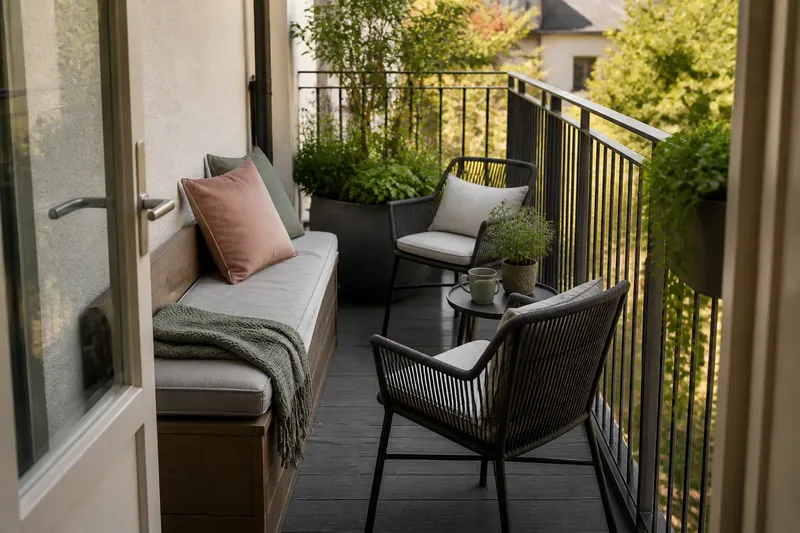
You turn sideways to water a pot, and the chair beside the balcony door catches your hip. Choosing a bench or separate chairs for a narrow balcony starts with this kind of ordinary moment: how you use the space when nobody is sitting down.
A bench can keep seating in one compact line; individual chairs can move to suit different conversations or tasks. Neither choice automatically takes less room. Seat depth, legs, arms and the space needed to pull a chair out all matter.
Measure the seating footprint
Look at the balcony with its door open, not just the empty floor. Note where the door swings, where a handrail or downpipe intrudes, and which areas you need to reach. A tape measure and masking tape can mark a proposed seat on the floor before you buy anything.
For a bench, mark the full length and depth, including any backrest that projects towards the usable floor. For chairs, mark each chair’s footprint and the extra room needed to sit down and stand up. A chair may look small when tucked in, then become awkward when pulled back.
Compare the whole arrangement rather than the furniture alone. Two chairs with space between them may occupy more usable floor than a bench of similar seating capacity. But a bench with a deep seat or bulky arms can be just as intrusive. Think of the footprint like a tray: its outside edges decide what else can fit, not the objects’ visual lightness.
Check the walking line from the door to the far end. This is not a project to redesign the route; it is a practical test of whether the proposed seat interferes with daily movement. If you have to shift furniture every time you open the door, that arrangement will probably feel demanding.
Bench seating patterns
A bench works well when people are happy to sit in a row and share a continuous seat. It can create a place for one person to read, two people to talk, or a visitor to perch briefly, depending on its length and the space around it. A backless bench can also be approached from either side, though it may be less comfortable for a longer sit.
Its main spatial advantage is a single, predictable outline. You can position it against a wall or railing if the bench’s design and the balcony conditions suit that placement. With no separate chair legs to reposition, the remaining floor is easier to assess at a glance.
The trade-off is less flexibility. A fixed bench does not turn towards a view or angle itself towards a companion. A long seat may also make one person feel they have to occupy the whole thing, while a short seat can limit how many people can use it comfortably. Consider how you actually sit: upright for coffee, angled towards a view, or tucked into a corner.
Storage benches introduce a different decision. Their enclosed base may be useful for outdoor items, but it adds visual and physical bulk. Check whether the lid can open without hitting the railing or wall, and whether anything stored inside needs ventilation or protection from damp.
Separate chair arrangements
Individual chairs allow each sitter to choose a direction. Two chairs can face one another, sit side by side, or turn towards the garden or street. That flexibility is useful if the balcony serves more than one purpose, such as reading alone and talking with a guest.
Chairs are also easier to move one at a time. You might bring one close to a planter for a quiet seat, or turn both towards a view. That only helps if there is room to reposition them; on a very tight balcony, moving a chair may simply shift the obstruction to another spot.
Pay attention to the chair shape. Arms make getting in and out easier for some people, but they widen the footprint and can prevent chairs from sitting close together. A curved back may feel inviting yet project further into the space. Lightweight metal or slim timber frames can appear less bulky, but comfort still depends on seat shape and back support.
Folding chairs offer a way to clear the floor when they are not in use. Before choosing them, decide where folded chairs will go. If they have to lean precariously against a door or railing, the storage solution may create a nuisance rather than freeing useful space.
Match seats to daily habits
Think about who uses the balcony and what happens there. A bench may suit someone who likes a continuous perch, wants to sit alongside a child, or prefers a simple line of furniture. Separate chairs may suit two people who like to face each other or a household where one person often sits alone.
Also consider how long you sit. A brief morning drink may not call for the same back support as a long reading session. Test the seat if possible, paying attention to whether your feet rest comfortably and whether the back supports you in your usual posture. Add cushions only if you have a sensible place to keep them between uses.
Say you have a narrow balcony with a door that opens inward, one large planter at the far end and two people who usually have coffee together. Mark a bench along the side wall with masking tape, then mark two chairs facing one another. If the bench leaves a comfortable place to pass but the chairs block the door’s opening, the bench is the clearer fit for those habits. If you often sit alone and want to face the planter, the chair arrangement may be worth keeping, provided it can be positioned without obstructing access.
Materials and practical checks
Furniture intended for outdoor use varies in how it handles rain, sun and changing temperatures. Powder-coated metal, treated timber, resin and other synthetic materials each have different care needs and finishes. Choose by the conditions on your balcony and the upkeep you are willing to do, not by appearance alone.
Look at the feet as well as the seat. Hard feet can scrape a balcony surface, while narrow feet may leave marks on some finishes. Glides can help, but they may wear or shift. If the balcony is exposed to wind, consider whether light furniture is likely to move and how you can secure or store it without blocking access.
For a bench, check that its legs sit securely on the floor and that the frame does not wobble. For chairs, try moving and sitting in each one; a chair that tips when you lean back is a poor match for a cramped setting. Follow the maker’s care and placement guidance, especially for materials and finishes exposed outdoors.
Which option fits your balcony?
Is a bench always better for a narrow balcony?
No. A bench can make the seating outline compact, but a deep or bulky model may take more room than slim chairs. Compare the occupied footprint and the space needed to use each option.
Can separate chairs work in a tight space?
Yes, if you can pull them out and sit down without blocking the door or making access awkward. Folding or stackable chairs may help when there is a real place to store them.
Which is better for two people talking?
Separate chairs make it easy to face one another, while a bench keeps both people side by side. Choose the arrangement that matches how you prefer to talk and how much turning room the balcony allows.
What should I mark before buying?
Mark the furniture’s full footprint, then show the door swing and the space needed to sit and stand. Walk through the arrangement with the marks in place before deciding.
Make the choice visible
Use masking tape or sheets of newspaper to outline the bench or each chair on the balcony floor. Open the door, walk to the areas you use, and mimic pulling a chair out or sitting on the bench. This simple mock-up turns a vague impression of spaciousness into a clear view of what the furniture will occupy.
For a narrow balcony, the best fit is the one that supports your usual seating arrangement without making everyday use feel like furniture Tetris. A bench tends to favour one steady line and shared seating; separate chairs favour individual positions and changes of direction. Let your marked-out footprint and preferred way of sitting make the final call.